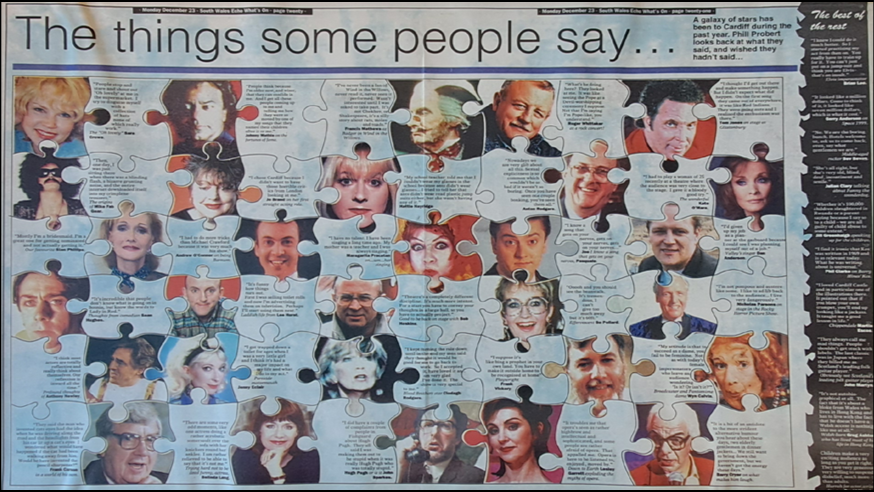
Centrespread from the South Wales Echo: What’s On – Christmas 1996
Headlines, AI Provenance, Design, and the 80/40 By-line
Before AI, and before the internet reshaped how we communicate, I worked as a graphic designer for a series of regional UK daily newspapers: the Newcastle Evening Chronicle, the South Wales Echo in Cardiff, and the Birmingham Evening Mail.
Producing a daily paper is an industrial production line. It usually starts out on the cold pavement with a reporter – full “Eddie Trenchcoat” style – chasing a lead. If the story warranted it, a photographer was sent along.
Their notes and photo rolls were fed back into the newsroom, where a small army of sub-editors chopped, checked, and polished the raw copy before passing it up to the chief sub and editor. They held the ultimate authority on where every piece lived: front page, page three, features, or sports and so on
Somewhere in the middle of that controlled chaos, the team needed the page designed.
That was my job. I had to merge raw stories, cropped photographs, and fixed ad blocks into a single coherent visual package. Multiply that by 36, 42, or however many pages were on the press schedule that afternoon, and send it down the line to be printed.
After eleven years, I moved on to other things (Another story for another day). Out of the thousands of pages I designed over a decade, I kept a thick portfolio of the ones I liked best.
And every so often, I look at them and ask the obvious question: Were they actually mine?
Well, technically, no. I didn’t write the headlines or the copy. I didn’t take the photos. I certainly didn’t run the printing press or drop the bundles on the corner newsagent’s curb. (Though I will still claim full bragging rights for an award-winning double-page spread in 1999.)
So why do I still think of them as mine?
Because they proved something specific: my ability to synthesise information and design at speed. I was good at it. The raw materials belonged to the newsroom, but the structure, balance, and visual hierarchy belonged to me. (And obviously as a part of a team of other designers)
When I transitioned into digital consultancy, that same underlying dynamic followed me. Working as a business analyst, project manager, and UX designer across digital transformation programs, you quickly learn that nothing meaningful is built in isolation.
When an online digital health dashboard goes live, or an agile delivery team hits its cadence, I know I didn’t build it alone. I didn’t write every line of code, configure every API, or map every database schema. My role has been to coordinate, design, facilitate, and keep the human intent clear amidst the technical noise.
To me – and likely to anyone who has spent decades working alongside production lines and software stacks – AI is simply another tool in the box.
It is a collaborator to be leveraged, pushed, and occasionally abused. In that sense, an LLM isn’t fundamentally different from a pocket calculator. You can use a calculator to solve complex structural engineering equations, or you can turn it upside down to spell out 8008135. The tool doesn’t care; the intent belongs entirely to the user.
Which brings us to where we stand today.
With Article 50 of the EU AI Act establishing a binding legal standard for machine-readable watermarking, synthetic text detection, and provenance disclosure, the debate over whether we should label AI content is effectively over.
The legal and technical machinery is already in motion. Compliance is no longer a philosophical option; it is a software spec.
So here is the final consultant’s summary – and the question we haven’t quite figured out how to answer:
If 80% of this essay originated in my own human memory, career history, and personal philosophy, but 20% was augmented, structured, or polished by a generative language model… does that disqualify me?
Does it invalidate all the observations made on the page?
If a watermark tags this text as “AI-Assisted,” does the reader discard the eleven years I spent in regional newsrooms?
Or do we accept that human authorship has always been a craft of orchestration, assembly, and final editorial responsibility?
I don’t have the answer. But the page is printed, and I’m putting my name on it.
First: LinkiedIn – August 15, 2026